

How to Choose a Pet Travel Carrier? The Latest 2026 IATA Standards Buying Guide,
Summary: Taking your pet on a plane? Choosing the wrong carrier could get it rejected by the airline at the airport. This guide walks you through the four key aspects — IATA standards, size, material, and safety design — to help you pick a compliant and safe pet travel carrier.
Every year, many pet owners get turned away at the airport because their carrier doesn't meet airline requirements. As a manufacturer with 10 years of experience in pet travel carriers, YIBEIER is here to explain everything you need to know in one go.
I. First, Understand: What Are the IATA Standards?
IATA (International Air Transport Association) has clear requirements for pet travel carriers, and most major domestic airlines (Air China, China Eastern, China Southern, Hainan Airlines, etc.) follow these standards. Key requirements include:
Carrier material: Must be hard plastic, wood or metal. Soft-sided carriers are never accepted for cargo hold transport.
Ventilation: Three-sided ventilation required; ventilation holes must cover no less than 16% of the carrier's surface area.
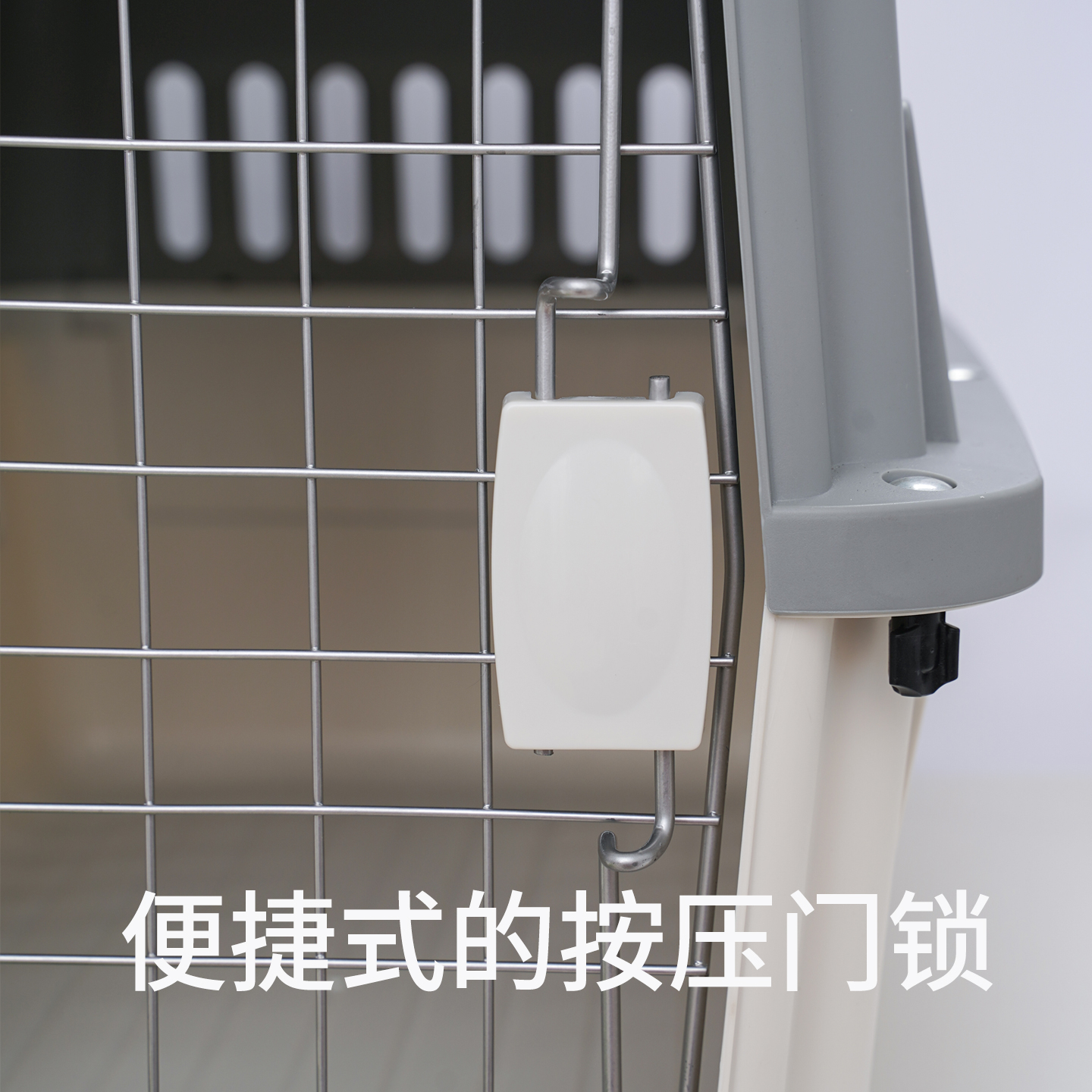
Door lock design: Must use spring-loaded locks, not simple snap fasteners.
Leak-proof bottom: Must be equipped with a removable tray to prevent leakage of waste.
Size requirement: When the pet stands, there must be at least 5 cm of clearance between the top of its head and the roof of the carrier.
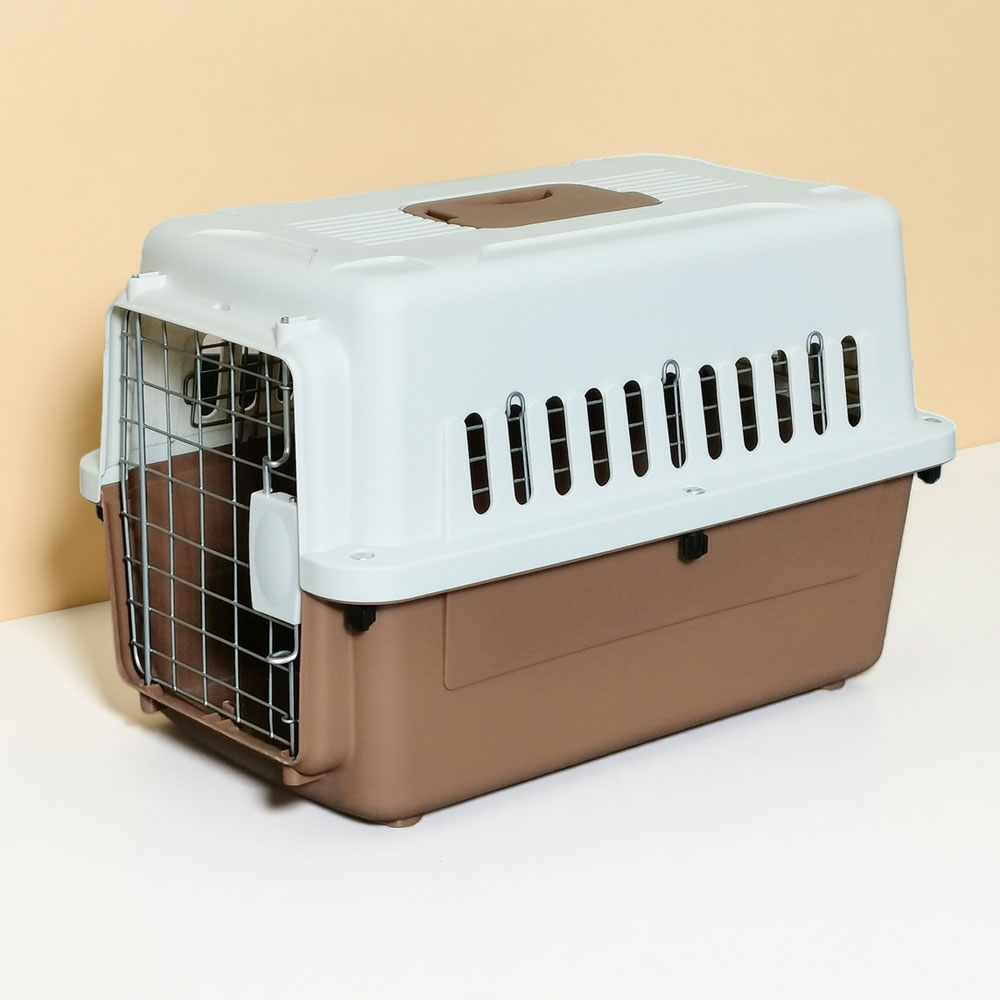
II. How to Choose the Right Size? Better Bigger than Smaller
The carrier size directly affects your pet's comfort and whether the airline will accept it. How to measure:
Have your pet stand naturally.
Body length = distance from the tip of the nose to the base of the tail.
Body height = from the ground to the top of the head (measure to the ear tips if ears stand upright).
Required interior length = body length + 1/2 of the front leg length.
Required interior height = body height + at least 5 cm.
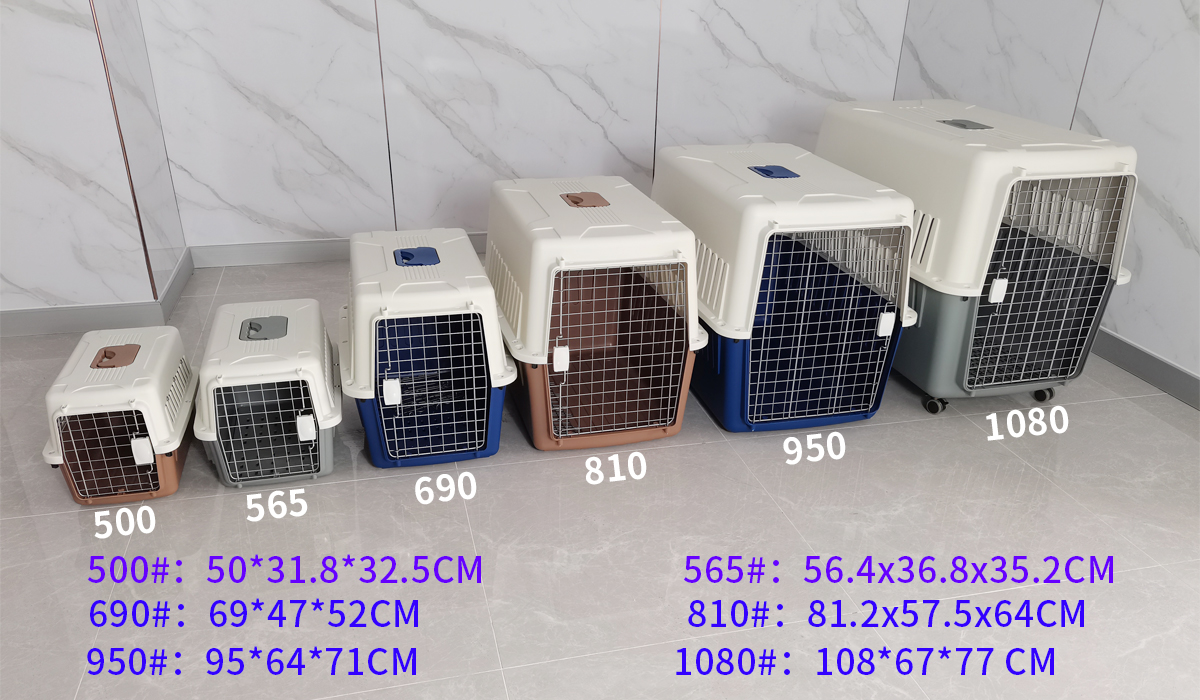
Common size references:
500# (approx. 50×33×32 cm): suitable for pets under 5 kg, e.g., Toy Poodle, Bichon Frise, British Shorthair.
690# (approx. 69×47×52 cm): suitable for pets under 15 kg, e.g., Corgi, French Bulldog, Shiba Inu.
810# (approx. 81×57×60 cm): suitable for pets under 25 kg, e.g., Border Collie, Samoyed.
950#/1080#: suitable for medium-to-large dogs over 30 kg.
III. What About the Material?
Mainstream carriers on the market are mainly made of PP:
PP (Polypropylene): Good toughness, impact-resistant, lightweight — ideal for small and medium pets, with excellent value for money.
IV. These 4 Safety Details You Can't Skimp On
Metal door grid spacing: Spacing should not exceed 3 cm to prevent pets from getting paws or mouths stuck; reinforced/extra-dense doors are also available with spacing under 19 mm.
Number of locks: At least 1 spring lock.
Reinforced corners: The four corners of the carrier should feature rib reinforcement so it won't deform during stacking and transport.
Matching accessories: Hanging bowls, pee pads, and ID tag hooks — these little extras can really make a difference in critical moments.
V. Final Reminders
Always confirm your airline's pet transport policy before booking tickets — requirements on temperature, breed, and carrier type vary by airline.
Brachycephalic (short-nosed) dogs/cats, such as French Bulldogs, British Shorthairs, and Persian/Exotic Shorthairs, are restricted on some airlines — check in advance.
Apply for your pet's cargo reservation at least 3 days ahead, as each flight has limited pet slots.
Choosing a compliant carrier is about being responsible to your pet and making your own trip worry-free. All YIBEIER carriers meet IATA standards and support OEM/ODM customization. Brand owners and trading companies are welcome to contact us.

